
“Employee engagement” . . . What’s the purpose?
Growing up in a large family business, I never struggled with finding purpose in work . . . it came naturally.
But it only took a few years as a business advisor to discover that my experience was the exception, not the norm.
I've come to believe that most people aren't disengaged because they're lazy. They're disengaged because nobody has helped them see why their work matters.
The data is striking. A 2025 Gallup study found that employees with a strong sense of purpose at work are 5.6 times more likely to be engaged than those with low purpose — and 27 percentage points less likely to be looking for a new job. Yet the same study found that only 18% of employees describe their current job as one that has a purpose they personally believe in. Nearly half — 45% — say they work primarily to collect a paycheck (https://lnkd.in/ekqnFcNQ)
There's a difference between showing up to complete tasks and showing up because you understand what those tasks are building. One is compliance. The other is contribution. And the gap between them is one of the most expensive problems in organizational life — and one of the least talked about.
Here's what I've learned: purpose isn't something people either have or don't have. It's something organizations either build or neglect.
When people can't see the connection between their daily work and something larger than the task list, they don't announce it. They quietly begin investing less — not from laziness, but from a rational conclusion that the extra investment isn't worth the return.
Your highest performers are usually the first to make that calculation. And then they leave.
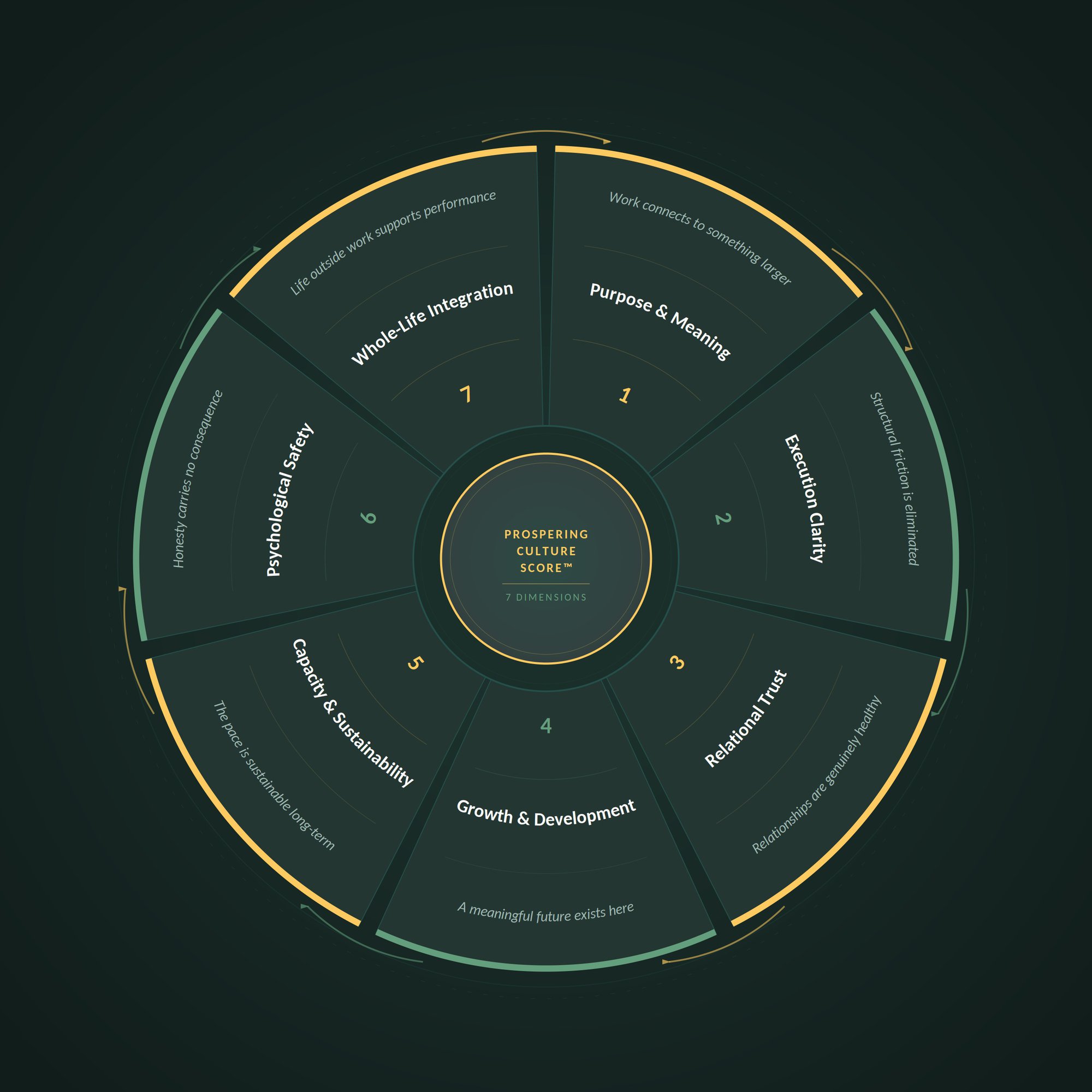
This is the first dimension of the Prospering Culture Score — Purpose & Meaning — and it asks one question: does work connect to something larger than the task list?
Not "are people satisfied?" Not "would they recommend the company?" Those are the wrong questions. The right question is structural: have we built the conditions that make purpose visible and real for the people doing the work?
I've seen organizations with compelling missions where nobody could articulate why their specific role mattered. And I've seen organizations in unglamorous industries where people were deeply invested — because leadership had taken the time to connect the work to something worth caring about.
The difference isn't the mission. It's the structure.
I developed the Prospering Culture Score based on years of seeing employee engagement efforts fall short. Instead of asking how people feel about their jobs, ask: do the conditions exist for sustained, high-quality performance?
-Learn more and get access at:https://lnkd.in/eBWct9ms
-Download the free E-Book:https://lnkd.in/eZgXCA_S